Carmen

Feeling giddy ... Michael Todd Simpson and Kirstin Chavez in Carmen.
Photo: Domino Postiglione
Up to that point, I had been inclined to agree.
The staging of Act 1 was flat, both visually and dramatically, with Tanya McCallin's set of ochre-stained concrete stressing the horizontal, while the direction, by Francesca Zambello and Denni Sayers, seemed intent on creating a crowded stage with formulaic flirtation. This chiefly involved cigarette girls being pawed, lifting skirts and straddling everything that moved and a few things that didn't, while in place of ideas a few gratuitous animals wandered listlessly around, provoking amusement.
However, Kirstin Chavez is an arresting Carmen, and although her seductive aspect in this act was about as subtle as watching tomcats having their tails pulled, the voice (even with a slight tendency to go sharp in this act) captures the same rich fleshiness and freedom as the persona.
As a performance, it grew in stature: in Act 3, when she keeps dealing the cards and finding death, Chavez was able to toll the low notes of her register with remarkable penetration and resonance. She remained statuesque and defiant in voice and spirit to the final moment, even when sprawled across the stage, pretending that the final rape attempt was more potent than it was.
Rosario La Spina's Don Jose was best in Act 2. Tenors need to save the best for the last act in this role. While there was no hint of vocal fatigue at the end (the less controlled moments were, in fact, in Act 1), the performance had passed its peak in terms of dramatic and vocal intensity.
Sarah Crane sang Micaela, the good girl's role, with an ideal mixture of vocal sweetness, fluid musical shape and suppressed inner fervour, and was one of the few characters whose on-stage dignity rivalled the horse.
As Escamillo the toreador, Michael Todd Simpson was tall and amiable, and a fine singer and table-top dancer: the persona and voice tended more towards the affable than the hypnotically erotic.
The support characters were strong, with Sian Pendry and Amy Wilkinson making an engaging gypsy pair in Act 3. Smugglers Luke Gabbedy and Graeme Macfarlane mercurially oiled the wheels of the action while troopers Andrew Moran and Shane Lowrencev failed to block its spokes.
The conductor, Richard Hickox, led a well-balanced orchestra with an unusually strong string section.


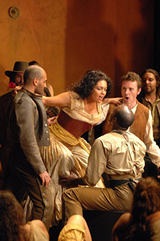 Francesca Zambello's production of Bizet's Carmen, which premiered at the Royal Opera House in 2006 and opened in Sydney on Thursday evening, opens with a striking, Goya-esque tableau of a handcuffed and bloodied Don José - the imprisoned murderer of Carmen. He's led roughly offstage and the opera follows as José's flashback.
 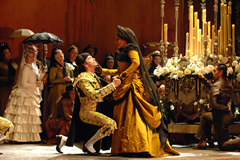 Carmen's cohorts Frasquita and Mercédès are sung by soprano Amy Wilkinson and mezzo Sian Pendry respectively, both current members of Young Artists programme. They sing with spirit and style; Pendry in particular shows real promise, displaying the sturdy, colourful voice of a Carmen in the making. Andrew Moran shows impressive vocal command as Moralès, while Shane Lowrencev makes an amusingly lecherous Zuniga. Luke Gabbedy and Graeme Macfarlane are the smugglers Dancaïro and Remendado, at their rascally best in the ensemble "Nous avons en tête une affaire".
 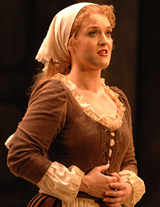 It's Cinderella, but not as we know it. Rossini's La Cenerentola retains the basic story - the downtrodden and virtuous cinder-girl who enchants a prince and transcends her nasty stepfamily - but excises its supernatural aspects. No transfigured rodents, no pumpkin, no glass slipper and no fairy godmother.
 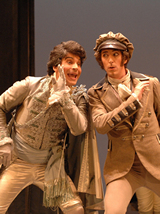 Don Ramiro is sung by Kanen Breen, one of Opera Australia's more unusual artists - a lyric tenor whose greatest asset is not his voice (appealing but rarely distinctive and occasionally worryingly constricted) but his prodigious gift for physical comedy. With his matinée idol features, he could be the illegitimate operatic offspring of Buster Keaton and Ivor Novello. He certainly makes a wonderfully funny Prince; but the fact remains that it's Prince Charming whom Cinderella falls for, not Prince Great Sense of Humour, and his characterisation, both physical and vocal, could have done with a touch more suavity.

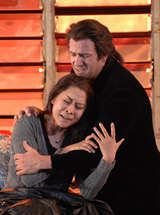 Updating operas isn't necessarily a risky business; there are ways of playing it safe. Simon Phillips' production of Puccini's La bohème, which opened Opera Australia's 2008 season, does just this. The sets and costumes are recognisably, and at times even surprisingly, modern-day - Rodolfo writes his poem on a laptop, the crowd around Café Momus includes a breakdancer in gold lurex, and the reunion of Mimi and Rodolfo takes place amid dumpsters and wheelie bins.
 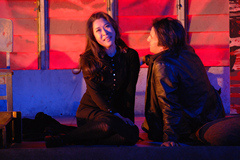 Chemistry aplenty, however, came from the opera's other couple, the fiery, on-again off-again pairing of Marcello and Musetta. José Carbo is in towering form as the former, his rich, expressive baritone dominating his every scene and easily filling the house. Amelia Farrugia brings wit, humanity and sparkling tone to Musetta.